
There are several BBA career options that you can explore right after graduation. MBA doesn’t need to be a mandatory step.
That said, this also depends on what you build during your undergraduate years. An internship, practical tools, projects, and communication skills can make a BBA graduate more prepared for roles after graduation.
Let’s dive in and understand the different roles.
Can you really get a job after BBA without an MBA?
Yes. A BBA is an undergraduate business degree that can prepare students for roles across different business functions.
Different career options that you can look at without an MBA can range from Business Development Executive to Sales Executive. The exact eligibility requirements, however, can vary by company and role.
What are the best BBA career options without an MBA?
There are several directions a graduate can explore immediately after completing a BBA.
Business development and sales
Sales and business development are common entry points for business graduates because they combine commercial understanding, communication, and relationship management.
BBA career options in this area include:
- Business Development Executive
- Sales Executive
- Business Development Associate
- Relationship Executive
- Account Executive
The work can involve finding potential customers, following up with leads, explaining products or services, managing accounts, and working towards business targets.
If you’re someone who enjoys communication, networking and working in a fast-moving environment, this could be a perfect fit.
Digital marketing
Marketing has become increasingly digital, creating several entry-level opportunities for graduates with a business background.
Possible roles include:
- Digital Marketing Executive
- Marketing Associate
- Social Media Executive
- SEO Executive
- Performance Marketing Associate
- Brand Executive
A BBA graduate can strengthen this pathway by learning tools and concepts such as SEO, Google Analytics, paid advertising, social media analytics, and content strategy.
For example, a student who completes a marketing internship and can demonstrate how they planned or measured a campaign has something tangible to discuss during an interview.
Finance and banking
Students with an interest in numbers can explore finance-oriented BBA career options without immediately pursuing an MBA.
Entry-level opportunities can include:
- Finance Executive
- Banking Operations Executive
- Relationship Manager
- Credit Processing Executive
- Financial Services Associate
- Accounts Executive
A finance-focused BBA can provide a foundation in accounting, economics, financial management, and business mathematics.
Human resources
HR is another career path where BBA graduates can enter the workforce directly.
Typical entry-level roles include:
- HR Executive
- Talent Acquisition Associate
- Recruitment Coordinator
- HR Operations Executive
- Employee Engagement Associate
The work can involve recruitment, candidate screening, onboarding, employee records, and engagement activities.
Business analytics
This is one of the more skill-driven BBA career options.
Businesses need graduates who understand both the commercial side of a problem and the data behind it. A BBA student does not need to become a data scientist to develop this capability.
Useful skills include:
- Advanced Excel
- Power BI
- Basic SQL
- Data visualisation
- Dashboard creation
- Business reporting
With these skills, graduates can explore roles such as:
- Junior Business Analyst
- Business Operations Analyst
- Reporting Analyst
- MIS Executive
- Business Intelligence Associate
For instance, a student could analyse monthly sales data, identify which products are performing differently across regions, and present the findings through a dashboard. That is a practical business problem, and it shows how management knowledge can be applied.
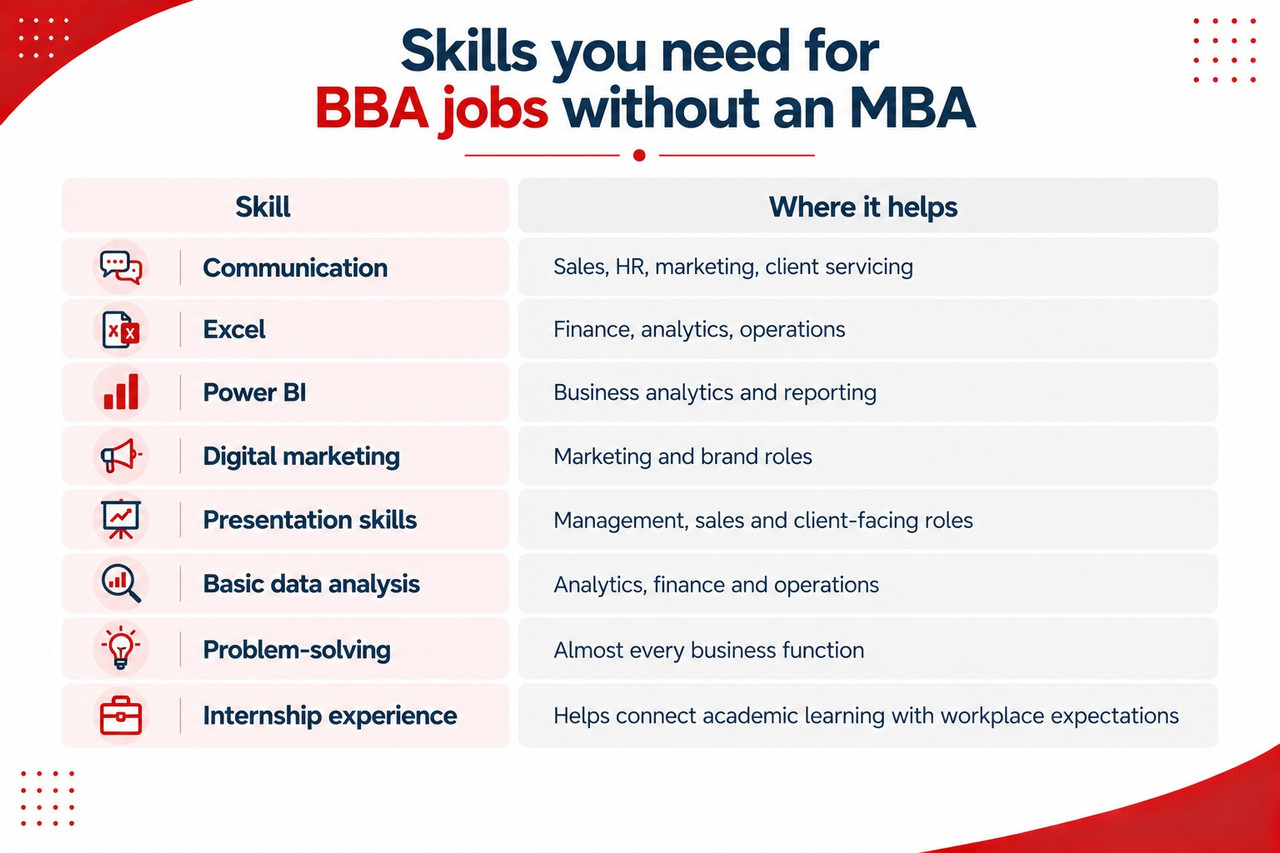
Why internships matter when you plan to work after BBA
Students who want to enter the workforce directly should use their undergraduate years to gain some understanding of how businesses operate.
An internship can help you:
- Work with actual business processes
- Understand workplace expectations
- Apply classroom concepts
- Build professional communication
- Add relevant experience to your CV
- Test whether a particular career actually interests you
This is particularly useful when you are choosing between different BBA career options. You may think you want marketing and discover through an internship that business analytics interests you more.
That discovery is valuable. You have three years of undergraduate study to experiment before making a longer-term career decision.
How can KL University prepare you for BBA career options?
For students who want to start working after graduation, the BBA environment matters.
At KL University, students are part of a larger multidisciplinary ecosystem with:
- An updated curriculum, 20% of which is taught by industry experts
- Harvard Case Pedagogy
- 1,400+ faculty members with 750+ PhD holders
- 350+ smart classrooms, 100+ labs, a digital library
- 92 global university partnerships
- Internship opportunities & 100% placements since 2006
- 30+ hobby clubs & fests
For a business student, this environment can support learning through different formats and open doors to multiple BBA career options.
Should you still do an MBA later?
You can, but you do not have to decide that immediately after Class 12.
One student may complete BBA, start working, and pursue an MBA after gaining experience. Another may go directly into postgraduate study. Someone else may build expertise through professional certifications.
Your first job can actually help you make that decision with more context.
The BBA gives you the starting point.
FAQs
Can I get a job after BBA without an MBA?
Yes. BBA graduates can apply for entry-level roles in sales, marketing, finance, HR, operations, business analytics, and customer relationship management. The requirements depend on the employer and role.
What are the most common BBA career options without an MBA?
Common options include business development, sales, digital marketing, HR, finance, banking operations, business analytics, supply chain, operations, and customer relationship roles.
Is BBA enough for a career in business analytics?
A BBA can provide the business foundation, while additional skills such as Excel, Power BI, basic SQL, and data visualisation can help you prepare for analytics-oriented roles.
Should I do an MBA immediately after BBA?
It depends on your career plans. You can start exploring BBA career options and decide later whether an MBA or another qualification would add value to your chosen career path.
Comments